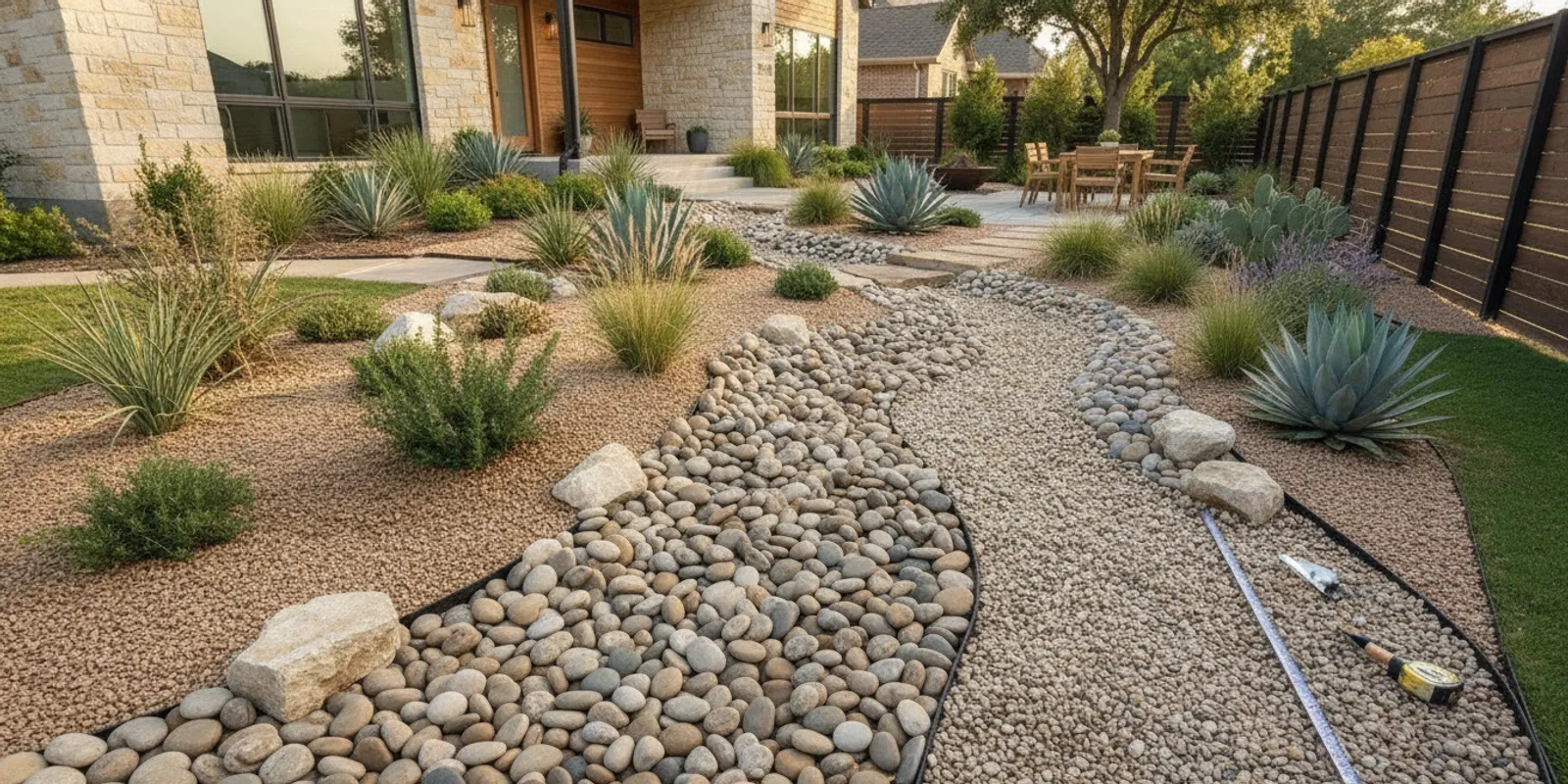
Buying bulk landscape rock starts with matching the stone to the job, then calculating the area and depth it must cover. A little planning helps homeowners and contractors order a useful amount, avoid choosing rock that does not suit the site, and prepare for unloading. Use this guide to compare common choices and work out the quantities before placing an order.
Talk through your landscape rock project
What job do you need the rock to do?
Begin with the purpose of the material, not its color. Landscape rock can finish a planting bed, cover exposed soil, define a path, fill a drainage area, or serve as a base material for a construction project. Those uses call for different sizes and shapes. A stone that looks attractive in a bed may not be comfortable to walk on, while a rounded decorative stone is not automatically suitable for a compacted base.
Write down what the finished area needs to do. Is it mainly decorative? Will people walk or roll equipment over it? Does water need to move through or away from the area? Will the rock sit around plants, edging, a building, or a downspout? These details narrow the choices before you compare samples or calculate volume.
- For a decorative bed: Consider the appearance, stone size, and how well the material fits the plants and edging.
- For a path: Think about how stable the surface should feel underfoot and whether the stone shape is comfortable for regular use.
- For drainage or construction: Confirm the material and installation approach for the actual site conditions. Do not assume a decorative rock is an engineered drainage or base solution.
- For a broad landscape area: Check how the finished color and size will look across the whole space, not just in a handful.
McCraw offers decorative landscape rock as well as bulk gravel. If the project calls for a particular stone, review the available Oklahoma Creek Rock and 3-inch Surge product pages as starting points, then check that the selected material matches the intended use.
How do you choose the right rock size and appearance?
Rock size affects the look, coverage, and practical feel of a finished area. Smaller pieces can create a more even-looking surface, while larger pieces make a stronger visual statement and leave more open space between stones. The best choice depends on the design and the job. For instance, consider how the rock will sit against low plants, the size of the bed, and how much movement or maintenance the area will receive.
Color is easier to judge when you see it beside the materials already on site. Compare the rock with the home exterior, paving, edging, and nearby plants. A color that appears subtle in a product photo may look more prominent when spread over a large area. If possible, look at actual material or an installed example before finalizing a design. Think about the view from several angles, including windows and the approach to the house. A large, uninterrupted bed can make even a modest color variation noticeable, while a small accent area may benefit from a more contrasting stone. Also consider how much of the rock will remain visible after planting. If foliage will eventually cover part of the bed, the rock is a background finish; if the bed is mostly open, its color and size will have a much stronger visual effect. A quick on-site comparison is more reliable than choosing from a name alone. McCraw’s project gallery can help you consider how materials look in finished outdoor spaces.
Ask for the available size range and whether the product contains a mix of sizes. A listed size is not always a guarantee that every piece is identical. This matters when you want a consistent appearance, need to fit stone into a specific space, or are trying to keep larger pieces away from a walkway. For example, the product listings for Arizona Rock in 1–2 inch size and Arizona Rock in 2–4 inch size show how a size choice can be part of the selection.
For a general background on rocks, minerals, and the geology behind natural materials, the U.S. Geological Survey is a government information source. Geological background does not replace a product specification or site-specific advice, so confirm the product details for your project before ordering.
How do you measure the area and estimate the quantity?
Bulk landscape rock is commonly ordered by volume. The basic calculation is length multiplied by width multiplied by the planned depth. Use the same unit for all three measurements. If you measure in feet, convert depth from inches to feet by dividing the inch measurement by 12. The result is cubic feet; divide that number by 27 to convert cubic feet into cubic yards.
Formula: length in feet × width in feet × depth in feet ÷ 27 = cubic yards.
For example, imagine a rectangular bed that is 20 feet long and 10 feet wide, with a planned rock depth of 3 inches. Convert 3 inches to 0.25 feet. The area is 20 × 10 = 200 square feet. Multiply 200 by 0.25 to get 50 cubic feet, then divide 50 by 27. The estimated volume is about 1.85 cubic yards. This is a planning estimate, not a guarantee of exact coverage; the final amount depends on the material and how it is placed.
Measure irregular areas by breaking them into simpler shapes. For an L-shaped bed, measure each rectangular section separately, calculate each volume, and add the results. For a roughly circular area, measure across the widest point to estimate its diameter, then use a practical approximation of the area or divide the space into smaller sections. If the edges curve significantly, take several measurements rather than treating the entire space as a perfect rectangle.
Depth is a design and use decision. Do not choose a depth simply because it makes the calculation easy. Consider the existing grade, the material’s size, the edging height, nearby doors or paths, and any plants that must remain clear. When you have a project specification or installation plan, use the depth it calls for. If you do not, ask a knowledgeable supplier or installer what is appropriate for your particular application.
For sloped ground, do not assume that one depth measurement tells the full story. A layer that is shallow at the high side may become much deeper downslope, while a level-looking bed can still have dips that take more fill. Measure across the area at several points, note the high and low spots, and decide whether grading is needed before adding rock. If the change in grade is significant or the material is part of a drainage plan, have the responsible installer determine the needed profile. A cubic-yard estimate is only as useful as the depth and grade assumptions behind it.
It can help to sketch the area and label each measurement. For example, if a bed wraps around a porch, split it into separate rectangles and label them A, B, and C. Calculate each rectangle using the same planned depth, then add their cubic-yard results. This makes it easier to find a mistake and revise only the affected section if the design changes. Keep units visible on the sketch: feet for length and width, inches for depth before conversion. Avoid rounding each small section too early; add the unrounded estimates first, then round the total sensibly when discussing the order.
McCraw’s landscape material calculator can help with area-based estimating. You can also compare the steps with the site’s crushed stone calculator. Check the calculator’s units and inputs, and review the result against your own measurements before ordering.
Which material should you compare for your project?
Rock and gravel are broad categories, not one interchangeable product. Compare the material’s stated use and characteristics with what you need the finished surface to do. The options below are general starting points; confirm the specific product details and suitability for your site before purchase.
| Project consideration | What to compare | Questions to ask |
|---|---|---|
| Decorative planting bed | Color, size range, and overall appearance | Will the size work around the plants and edging? How will the color look across the whole bed? |
| Path or frequently used area | Stone shape, surface stability, and comfort | Will the material shift underfoot? Is it a suitable choice for the expected use? |
| Drainage-related area | Material specification and site design | What is the water route? Does the material and installation plan fit the site conditions? |
| Base or construction work | Specified aggregate and compaction requirements | Does the project plan call for this exact material? What preparation and installation steps are required? |
For a job that needs a specific crushed material, compare suitable listings such as Road Base rather than assuming decorative landscape rock will perform the same way. If the design calls for a rounded smaller stone, review the pea gravel details. If a project specification names a material, use that specification as the guide and confirm any substitution with the responsible installer or designer.
What should you check before you place the order?
After choosing a material and estimating volume, do a quick review of the site and the order details. Recheck all measurements and the planned depth. Confirm the product name and size, how much you intend to buy, and whether the estimate is expressed in cubic yards or another unit. Keep a note or sketch of how you divided an irregular space; it makes it easier to identify a mistaken measurement before material arrives.
- Check the boundaries: Measure the area that will actually receive rock, not the whole yard or an adjacent paved surface.
- Account for the grade: A sloped or uneven bed may not have uniform depth. Ask how the area should be measured if the change in elevation is substantial.
- Check edges and clearances: Make sure the planned finished level works with edging, paths, thresholds, existing plants, and any drainage features.
- Confirm product details: Verify material, size, and current availability rather than relying on a generic category name.
- Plan for some uncertainty: Measuring and placement are not perfectly precise. Discuss your estimate if a shortfall or excess would create a problem.
Rock should be planned as part of the finished landscape, not treated as a last-minute layer. If the area needs clearing, grading, a barrier, edging, or a particular base, decide how those steps fit into the project before the delivery date. Keep the planned depth in mind while preparing the bed so that adding the rock does not raise the surface beyond the intended level.
How do you prepare the site for bulk landscape rock?
Prepare the area so the delivery and installation can proceed without avoidable delays. Mark the boundaries of the bed and identify areas that should remain clear. Move vehicles, tools, and other obstacles out of the planned work zone. If there are irrigation lines, low-voltage wiring, drains, or other buried or surface features, locate and protect them before digging or moving material.
Decide where the material will be placed and how it will travel from the drop point to the finished area. A pile that is easy to reach may still block a driveway, gate, sidewalk, or another part of the job. Check access, overhead clearance, turning room, and the surface where the truck or equipment may need to go. Tell the supplier about access constraints when arranging delivery so the drop location can be discussed in advance.
For the bed itself, remove unwanted vegetation and loose debris, then shape the area according to the project plan. Establish edging where needed and check the grade before spreading stone. Avoid covering plant crowns, drains, or other features that need to remain visible or functional. When the project involves drainage, retaining structures, or a construction base, follow the appropriate design or installer instructions rather than improvising based on appearance alone.
How should you plan delivery and placement?
Bulk material is usually more practical for larger projects than carrying many small bags, but delivery requires a clear plan. Before setting a date, confirm the order, the requested material, the estimated quantity, the site address, access conditions, and the preferred drop location. Ask about delivery timing and any requirements that affect unloading. A scheduled delivery is easier to manage when the area is measured, accessible, and ready to receive the material.
Think through the route from the drop point to the work area. If the pile will be some distance from the bed, plan who or what will move the rock and how much time that will take. For a contractor, coordinate delivery with the crew and installation sequence. For a homeowner, check that help, tools, and site access will be available on the day the material arrives.
Before confirming the schedule, consider what could make unloading difficult. Soft ground, narrow gates, low branches, parked vehicles, overhead lines, and tight turns may affect where a delivery vehicle can go. Do not assume a truck can cross a lawn or reach a backyard simply because a person can walk there. Describe the approach and unloading area accurately, and ask what access is needed. If there is no suitable drop point close to the work, factor in the extra handling effort when deciding whether the quantity and schedule are practical.
For a multi-part project, plan the order of work so that the material does not arrive before the site is ready. Finish any excavation, edging, and required base work first, and make sure the drop area will remain available. If crews are working on several areas, label the intended material location and keep a copy of the measurement sketch available. Clear communication about what is being delivered and where it should go reduces the chance of disrupting the rest of the job.
Ordering the exact calculated amount may not always be the best plan if measurements are uncertain or the area is irregular. At the same time, ordering substantially more than needed can leave excess material to store or dispose of. Use your calculation as a reasoned estimate, then clarify the product’s expected coverage and the best order quantity with the supplier. The right decision depends on the accuracy of your dimensions, depth, and placement plan.
If you are comparing options, review the full landscape supply product selection and the information on McCraw’s homeowner and landscape material supply. For local service details, use the locations page. These pages can help you identify the next step, but confirm material, quantity, and delivery details directly before committing to the project schedule.
What common estimating mistakes should you avoid?
- Forgetting to convert depth: Inches must be converted to feet when length and width are in feet. Using 3 as though it were 3 feet instead of 3 inches produces a dramatically different estimate.
- Measuring only one side: Width can vary along a bed. Take more than one measurement where the shape changes.
- Using the whole property area: Subtract paths, patios, and planting areas that will not receive rock.
- Choosing depth without considering the site: Match the planned layer to the design and material, and check edges, plants, and drainage features.
- Assuming all rock behaves alike: Product size and shape affect appearance and use. Confirm the material rather than substituting by color alone.
- Ignoring where the truck can unload: Confirm access and the drop point before delivery, not after the vehicle arrives.
A simple project worksheet can prevent many of these problems. Record each section’s length and width, the planned depth, the calculation, the selected product, and the delivery notes. If you revise the design or change the stone, update the estimate rather than carrying forward a number based on a previous plan.
When comparing alternatives, look beyond the per-unit amount. A rock that appears less expensive may need a different depth, cover less area at the chosen installation depth, or require more labor to move and spread. A product that is visually appealing but unsuitable for the surface may also create rework. Ask what quantity unit is being quoted, how much area the estimate assumes, and whether delivery is included or handled separately. Comparing the same quantity basis, material size, and delivery assumptions makes the options easier to evaluate fairly.
Homeowners and contractors may also approach the estimate differently. A homeowner planning one bed may value a simple order and a manageable drop point. A contractor coordinating multiple areas may need product consistency, a clear sequence, and a delivery location that keeps the crew moving. In either case, give the supplier accurate dimensions and the intended use. If the project design is still changing, explain what is settled and what is provisional before requesting a final order recommendation.
Contact McCraw about your material and quantity
Plan the material around the finished space
A successful bulk landscape rock order begins with a clear purpose, a suitable material, and careful measurements. Compare size and appearance in context, calculate volume with consistent units, and prepare both the bed and the delivery area. When you are ready, share your measurements and project use with McCraw so you can confirm the product and order details before work begins.
