Ordering too little gravel can stall a project, while ordering too much ties up money, space, and time. In North Texas, a dependable estimate starts with three measurements: the area you need to cover, the finished depth, and the material you plan to use.
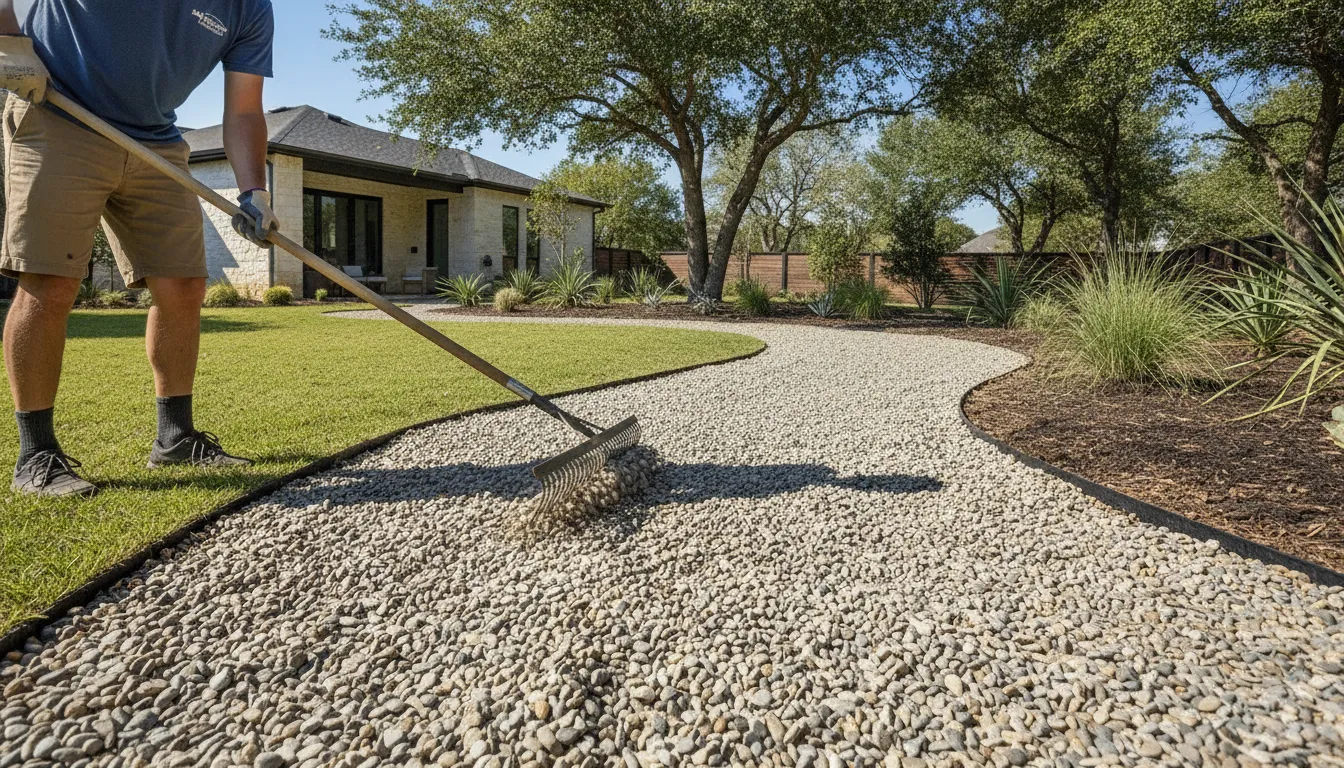
A gravel calculator turns length, width, and depth into an estimated volume, usually in cubic feet or cubic yards. It can also help estimate weight, but that step depends on the gravel’s density, particle size, and moisture. Use the result as a planning point, then confirm the product and ordering unit with your supplier.
Calculate your project materials with McCraw’s area calculator, then review the result before arranging pickup or delivery in Van Alstyne, Anna, or nearby communities. The key is knowing what the calculation describes, and what it cannot decide for you.
What Does a Gravel Calculator Actually Tell You?
A gravel calculator turns your covered area and planned depth into an estimated volume of material, then may convert that volume into weight or cost. The result is a planning estimate, not a universal order quantity, because gravel density changes by material, particle size, and moisture.
Start with the part that is easiest to verify: the space you need to cover. A calculator uses project dimensions such as length, width, and depth to determine volume. For irregular projects, some tools also accept a circle, diameter, or radius. Depth matters just as much as square footage. A shallow decorative layer and a deeper base layer may cover the same footprint but require very different amounts of gravel.
What the volume result means
Volume tells you how much physical space the material must fill. Depending on the calculator, the result may appear in cubic feet or cubic yards. Those are volume measurements, so they describe the space occupied by the gravel rather than how heavy the load will be. If your measurements are in feet, the basic calculation is length multiplied by width multiplied by depth. Cubic feet can then be converted to cubic yards by dividing by 27.
This is useful when a supplier lists a material by the cubic yard. It also gives you a consistent quantity to review with a materials professional before placing an order. Keep your depth measurement in feet when doing the calculation, or convert inches to feet first, so the units stay consistent.
Why weight is a separate estimate
Weight requires another piece of information: density. A calculator uses an assumed density to convert volume into pounds or tons. That assumption can be reasonable for an estimate, but it should not be treated as a fixed conversion for every gravel product. Different rock types, sizes, and moisture levels can change the weight of the same volume.
This distinction matters for both homeowners and contractors. You may calculate a project volume correctly and still receive a different weight estimate after the selected product and its current condition are confirmed. Larger aggregate can also cover differently than smaller material, so product selection should happen before you treat a ton estimate as final.
What a cost result can and cannot tell you
Some gravel calculators estimate cost as well as volume and weight. That output is only as useful as the price entered or supplied by the tool. Material type, quantity, availability, delivery, and the supplier’s current terms can all affect the final purchase decision. Use cost output for early planning, then confirm the selected product and ordering unit before committing.
McCraw’s area calculator helps customers estimate material quantities during the planning stage, before comparing costs and purchasing. Use McCraw’s area calculator to check your area, depth, and estimated quantity, then review the result against the specific gravel you plan to use.
How a Gravel Calculator Turns Project Dimensions Into a Quantity
Short answer: Measure the project in consistent units, multiply length by width by depth to find volume. Convert inches to feet when needed, and divide cubic feet by 27 to get cubic yards. Tons are different: they require a density-based conversion for the specific gravel, not volume math alone.
Start by measuring the area you plan to cover. For a rectangular bed, driveway, walkway, or pad, record the length and width in feet. Then determine the finished gravel depth. Since depth is often measured in inches, divide it by 12 before using the formula. A 3-inch layer becomes 0.25 feet, while a 6-inch layer becomes 0.5 feet.
The core calculation is simple:
Length in feet x width in feet x depth in feet = cubic feet of material.
For example, a 20-foot by 12-foot area with a 3-inch depth uses 20 x 12 x 0.25, or 60 cubic feet before any project-specific allowance. To convert that volume into cubic yards, divide by 27 because one cubic yard contains 27 cubic feet. In this example, 60 cubic feet divided by 27 equals about 2.22 cubic yards.
| Unit or input | What it represents | How to use it |
|---|---|---|
| Length and width | Project dimensions in feet | Multiply them to find square footage |
| Depth | Finished gravel thickness | Convert inches to feet by dividing by 12 |
| Cubic feet | Calculated volume | Length x width x depth |
| Cubic yards | Common volume-based ordering unit | Divide cubic feet by 27 |
| Tons | Material weight | Convert volume using the selected product’s density |
Why cubic yards and tons do not mean the same thing
Gravel is commonly sold by the cubic yard or by the ton, but those units answer different questions. Cubic yards describe how much space the material occupies. Tons describe how much the material weighs. A gravel calculator can estimate weight by applying density to the calculated volume, but density changes with material type, particle size, and moisture content. That is why a decorative rock, crushed limestone, and another gravel product should not automatically be assigned the same tons-per-yard conversion.
Use your calculated cubic yards as the starting quantity, then confirm the selected product’s ordering unit and conversion with the supplier. If the calculator asks for decimals, enter 0.25 rather than a mixed fraction such as 1/4. This keeps the calculation consistent and makes it easier to compare the result with the product information for your North Texas project.
Worked Example: Calculating Gravel for a North Texas Project
Answer summary: A 20 ft by 12 ft area covered to a 3-inch depth requires 60 cubic feet, or about 2.22 cubic yards, before any planning buffer. With a general 10% allowance, the estimate is about 2.44 cubic yards. Treat that figure as a planning estimate, not a guaranteed final order.
Here is the full calculation for a rectangular project, such as a small path, pad, or landscape bed. The method is simple, but each unit needs to stay consistent. Measure length and width in feet, convert depth from inches to feet, calculate cubic feet, and then convert the result to cubic yards. A standard volume formula multiplies length by width by depth. A cubic yard contains 27 cubic feet.
- Measure the area. The project is 20 ft long and 12 ft wide. Multiply those dimensions: 20 x 12 = 240 square feet.
- Convert the planned depth. The desired gravel depth is 3 inches. Divide 3 by 12 inches per foot: 3 / 12 = 0.25 ft. Using 0.25 instead of 3 in the volume formula keeps all dimensions in feet.
- Calculate cubic feet. Multiply the area by the depth: 20 x 12 x 0.25 = 60 cubic feet. This is the volume that fills the measured space at the planned depth.
- Convert cubic feet to cubic yards. Divide 60 cubic feet by 27: 60 / 27 = 2.22 cubic yards, rounded to two decimal places. This is the base material estimate before allowing for variation.
- Add a general planning buffer. A commonly cited starting point is 10% additional material for overage. Ten percent of 2.22 cubic yards is 0.222 cubic yards. Add it to the base estimate: 2.22 + 0.222 = 2.442, or about 2.44 cubic yards. This is a general planning rule, not a promise that every project needs exactly 10%.
Do not automatically convert the 2.44 cubic yards into tons using a universal factor. Gravel weight can vary with the selected material, particle size, and moisture content. A gravel calculator may use density to convert volume into weight, but the result is product-specific.
The general overage guidance is also separate from compaction decisions. A compacted driveway base, uneven grade, sloped area, or project with difficult edges may require a different review than a level decorative bed. Treat the 10% figure as estimating guidance rather than a substitute for product advice.
Before buying, confirm whether the selected McCraw product is ordered by cubic yard, ton, or another unit, and ask how its density affects the final quantity. Bring the measured dimensions, intended depth, application, and the 2.44-cubic-yard planning estimate to that conversation. That gives the supplier enough context to refine the order instead of relying on a generic conversion.
How Much Extra Gravel Should You Order?
Plan on a modest overage for normal measurement gaps, but do not treat one percentage as a guarantee. A general rule of thumb is to add about 10% to the calculated quantity. That buffer can help cover irregular edges, small areas that were missed during measuring, grade variation, and material that remains in the truck, loader, or wheelbarrow during installation. It is a planning starting point, not a promise that every project will use exactly that amount.
Begin with the clean volume calculation, then decide how much uncertainty your site introduces. A simple rectangular bed with a consistent grade is easier to estimate than a winding path, sloped yard, or driveway with several transitions. If the shape has curves or notches, divide it into smaller rectangles and triangles where possible. Measure each area separately, add the volumes, and then apply the buffer to the combined total rather than guessing from the overall footprint.
Account for grade changes and irregular edges
Depth is an average across the project, not necessarily the exact depth at every point. Low spots may need more material, while high spots may need excavation or grading before gravel is placed. Along borders, gravel can also spread beyond the intended line unless edging or another restraint is already installed. These conditions are why a neat calculator result should be reviewed against the actual site before ordering.
- Irregular shape: Add time for missed corners, curves, and transitions when checking the measurement.
- Uneven grade: Confirm whether the planned depth is an average, a minimum, or a finished-grade target.
- Handling loss: Allow for small amounts left during loading, transport, spreading, and cleanup.
- Material fit: Confirm that the selected rock size and product are suitable for the intended surface before finalizing the quantity.
Compaction needs a project-specific decision
Compaction is different from ordinary edge or handling waste. When gravel is placed as a driveway or structural base, the material may settle as it is compacted. A gravel reference notes that compaction can reduce the volume needed to fill by as much as 30%. That figure describes conditions that vary by material, lift thickness, subgrade, moisture, and equipment. It should not be converted into a universal ordering promise.
Driveway depth is useful context, but it is not a one-size-fits-all prescription. One reference gives 4 to 6 inches as a recommended driveway range. The right build-up depends on traffic, drainage, soil, and whether the gravel is decorative cover or part of a base system. For a driveway or construction project, confirm the intended section and compaction approach with the person responsible for site preparation.
Use the calculated volume as your baseline, add a clearly labeled general buffer when appropriate, and ask for product-specific guidance before converting that quantity to tons. This keeps your order practical without disguising a site judgment as a precise calculator output.
How Do You Choose the Right Gravel Before Ordering?
Summary: Choose the material for the job first, then confirm its size, density, moisture conditions, and ordering unit before relying on a quantity estimate.
The right gravel depends on more than the square footage of the project. A driveway base, drainage feature, walkway, and decorative bed each call for a different material profile. Product size affects how the rock spreads and settles, while density and moisture affect the relationship between cubic yards and tons. Entering a generic conversion into a gravel calculator without identifying the product can make an estimate look precise while still missing the mark.
Start with the job, not the quantity
First decide what the material needs to do. Crushed limestone may be a practical fit when the project needs a compactable aggregate or stable base. River rock can work better for decorative ground cover, dry creek beds, or certain drainage applications, where rounded stone and appearance matter. Decorative rock is selected primarily for the finished look, but size still affects coverage, stability, and how easily the material moves under foot or equipment.
McCraw Landscape Supply offers crushed limestone, river rock, and decorative rock for homeowners, contractors, and builders in Van Alstyne, Anna, and surrounding North Texas communities. If you are comparing base materials, this guide can help you choose the right gravel for the performance your project requires.
Check size, density, and moisture
Particle size changes both appearance and coverage. Larger gravel generally covers less area per ton than smaller gravel because the size range and voids between particles differ. River rock illustrates why this matters: McCraw’s Austin River Rock is available in 5/8 to 1 inch, 1 to 2 inch, and 2 to 4 inch sizes. Those options can create different visual results and may suit different drainage or landscape applications.
Weight also varies with material type, particle size, and moisture content. A load that is wet may weigh more than the same volume when drier, and two products with the same cubic-yard measurement may not have the same tonnage. Treat published conversion ranges as estimates, not a universal rule. Before ordering by weight, ask McCraw to confirm the selected product’s applicable conversion and ordering unit.
- Identify the use: base, driveway, drainage, walkway, or decorative cover.
- Choose the size range that fits the project’s function and finished appearance.
- Record your calculated volume in cubic feet or cubic yards before converting to tons.
- Account for moisture and product density when comparing volume with a weight-based order.
- Confirm availability, delivery details, and the final quantity with the supplier.
For a closer comparison of rounded stone and angular gravel, read about gravel for your project. Then use McCraw’s estimate as a planning starting point and verify the material choice before placing the order.
Talk with McCraw about your gravel order
Frequently Asked Questions About Gravel Calculators
Should I calculate gravel in cubic yards or tons?
Start with cubic yards because that is the volume your area and depth produce. Convert to tons only after you identify the specific gravel product. Gravel is commonly sold by the cubic yard or ton, and density changes with material type, particle size, and moisture content. A calculator can estimate weight from volume and density, but there is no universal tons-per-yard conversion. The material specification matters because density varies by product.
How deep should I plan for a gravel project?
Use the finished depth your project requires, measured in inches and converted to feet before multiplying length by width. Walkways, decorative areas, driveways, and compacted bases can need different depths, so do not copy a depth from another project without checking the intended use and grade conditions. If you are unsure, confirm the application and product with the material supplier before ordering.
Should I add extra gravel to my calculation?
Usually, yes. A general planning approach is to add about 10 percent for ordinary overage, such as uneven grade, edge loss, or small measurement errors. Compaction can require a separate project-specific adjustment, especially for a driveway or aggregate base. Treat the buffer as an estimate, not a guarantee. Avoid adding a fixed percentage without considering how the material will be placed and compacted.
Can a gravel calculator tell me exactly how much to order?
It gives you a strong starting estimate from your dimensions, depth, and selected material, but the final order can vary. Product size, density, moisture, compaction, grade changes, and delivery constraints all matter. Enter accurate measurements, review the result in the unit your supplier uses, then confirm the quantity for the specific gravel you plan to buy.
Ready to Check Your Gravel Quantity?
Use McCraw’s area calculator to check the project quantity after measuring your length, width, and planned depth. A quick review can help you confirm the material and ordering details before the load is arranged. For questions about which gravel fits your application or how to plan the order, contact McCraw through the website. Share your measurements and project goals so the team can help you take the next practical step.
