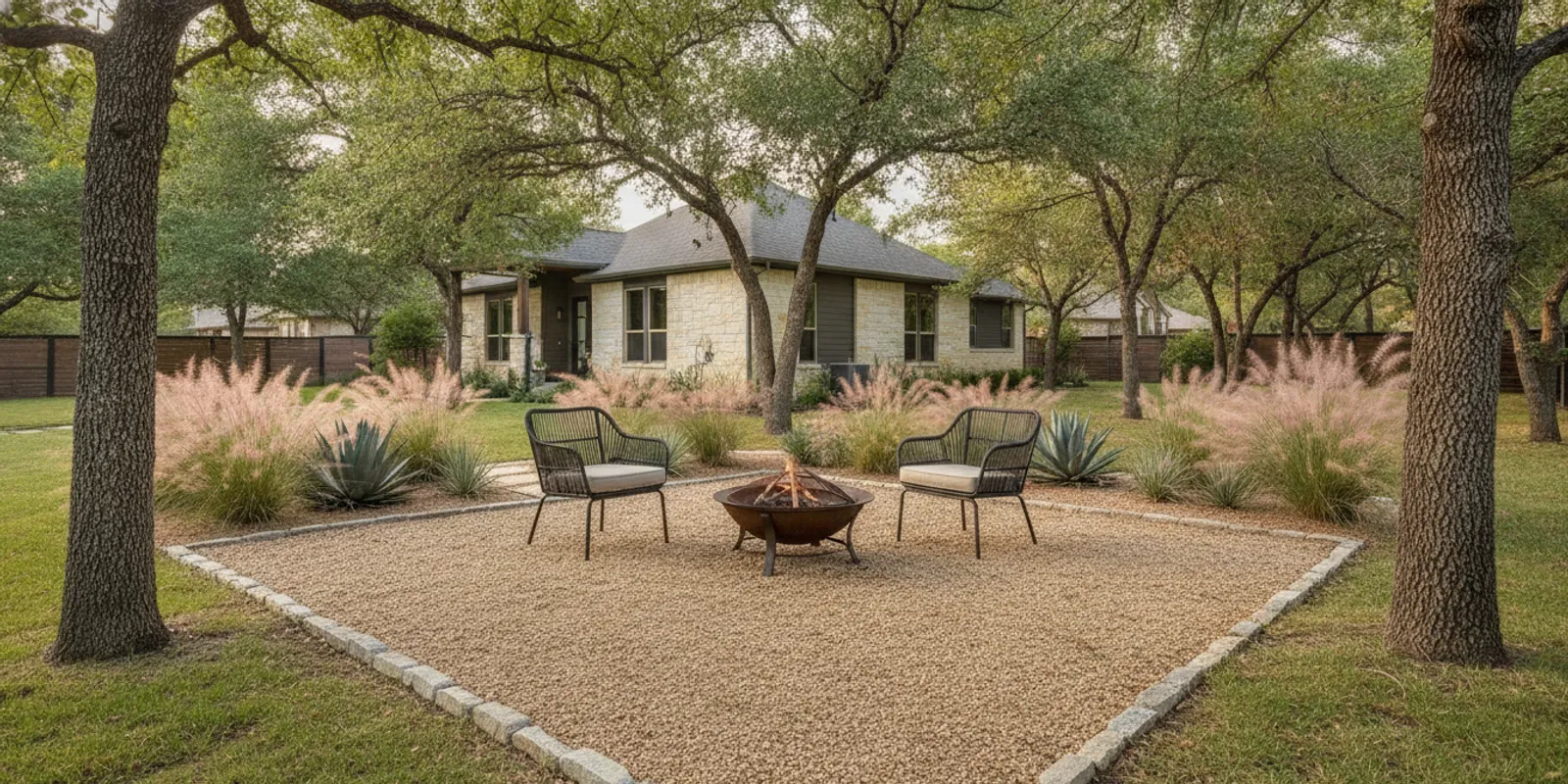
Choosing gravel for patios starts with how the space will be used, not with color alone. A place for a dining table needs a firmer surface than a decorative corner, and a garden path has different demands from either one. In North Texas, plan for drainage, a stable base, edging, and the feel of the stone before ordering.
Ask about materials for your patio
What do you want the patio to do?
Write down the main use before comparing products. A gravel patio can be a relaxed outdoor room, a place to set a few chairs, or a transition between the house and garden. Those uses do not demand the same firmness or maintenance. Think about who will use the space, how often furniture will move, and whether you need a clear route from a door to the seating area.
- Dining or frequent seating: Choose a surface that can be prepared to feel relatively firm and level. Chairs need to stay upright, and table legs should not sink into loose stone.
- Occasional sitting: A more decorative surface may be acceptable if you are comfortable with some shifting and periodic raking.
- Garden path: Consider the walking line, the stone underfoot, and an edge that keeps gravel from migrating into planting beds.
- Fire feature or grill area: Think through the appliance requirements, clearances, and local safety guidance separately. Gravel alone does not establish a safe installation.
Also consider how the patio meets the house, lawn, and nearby doors. If loose material touches a threshold, it can be tracked indoors. If it meets turf, stones can get caught in mowing equipment or spread into the grass. A defined border and a sensible transition help make the space easier to use.
Sketch the footprint with furniture drawn to scale. Include room to pull chairs back and walk behind them. A patio that fits the table but leaves no working space around it may feel cramped once built. For a small project, outline the proposed edge with a hose or stakes and walk through the area before digging.
Which gravel qualities affect comfort and stability?
“Gravel” refers to a range of stone products. Particle size, shape, and grading determine how the material feels and whether it can compact. Angular particles can fit together and resist rolling when the material and installation are suitable. Rounded decorative stones tend to move more underfoot. A finer product may provide a more uniform finish, but it still needs a correctly prepared base and appropriate drainage.
Ask about the product’s actual size range and whether it contains fines. Fines are small particles that fill gaps between larger pieces in some mixes. They can contribute to a tighter surface, but the outcome depends on the material and site. Do not assume every product called gravel is intended to serve as a finished walking surface. A supplier can explain product characteristics; confirm the installation design for your conditions.
| Surface option | Typical behavior | May fit when | Questions to ask |
|---|---|---|---|
| Angular, compactable gravel | Can form a firmer surface when placed and compacted in appropriate layers | You expect regular seating or walking | What is the size range? Does it include fines? What base is recommended? |
| Rounded decorative rock | Moves more underfoot and may be harder to keep level | Appearance matters most and traffic is light | Will this size roll under chairs? Is it intended for a walking surface? |
| Screenings or decomposed-granite-type material | Fine particles can create a smoother finish when prepared correctly | You want a fine appearance and can follow suitable installation guidance | Does this material suit the site, drainage, and intended use? |
| Stone or paver patio | Provides a defined walking surface with joints and base requirements | You need a more stable area for furniture or frequent movement | Which bedding and joint materials does this design require? |
This comparison is a starting point, not a product specification. Compare the gravel options and decorative rock categories, then ask how a particular size and grading behave. The guide to gravel versus river rock can help clarify the difference between compactable aggregate and rounded decorative stone.
How should you plan a base and drainage?
The visible surface is only one part of a patio. The soil below it, the base material, the finished grade, and the edge all affect whether the area stays usable. A thin decorative layer spread over soft or uneven ground can develop dips, ruts, or patches where the underlying fabric shows. A prepared base can support the finish more consistently, but its design depends on soil, loading, material, and drainage.
- Mark the footprint. Stake corners or trace curves. Check the dimensions with the furniture and circulation space you have planned.
- Look at water flow. Note where water comes from and where it goes after rain. Avoid creating a low basin or directing runoff toward the home or a neighboring property.
- Determine the finished elevation. Compare the patio with door thresholds, steps, lawn, and nearby hard surfaces. Allow for the depth of all planned layers, not only the visible gravel.
- Remove unsuitable surface material. Organic debris and loose, unstable top material can interfere with a consistent base. The necessary excavation depends on the design and site.
- Prepare the base in planned layers. Use material and compaction methods appropriate for the project. Follow product and installation guidance rather than assuming the decorative finish can serve as its own base.
- Set the edge. A firm border helps retain loose aggregate. Position it so it does not create a trip hazard or obstruct the intended drainage route.
- Spread and finish the surface evenly. Check the final level and walk it before moving furniture onto it. A thick, loose layer can make chairs unstable and walking tiring.
Observe the site after rain if possible. Where water stands, running straight across the patio, or entering from an uphill area, the solution may involve grading or a drainage plan rather than a different decorative stone. A North Texas yard can include compacted or clay-heavy soil, so do not rely on a general depth rule to solve every site. If the area has a strong slope, water near a foundation, or a large elevation change, get advice on the site design before ordering material.
The Texas A&M Forest Service’s Cross Plains, Texas Wildland Fire Case Study mentions pea gravel or river rock within the first few feet of a home’s exterior walls as a possible landscape measure in wildfire-conscious settings. That observation is specific to the case study’s fire context. It is not a patio construction specification, and it does not replace local building, drainage, or fire guidance.
How do you calculate how much gravel to order?
Measure the area and decide on a planned depth for each layer. For a rectangle, multiply length by width. For an irregular footprint, split it into rectangles or other simple shapes, calculate each area, and add the results. Convert the depth from inches to feet, multiply square feet by depth in feet to get cubic feet, and divide by 27 to get cubic yards.
Worked example: A patio measuring 12 feet by 15 feet has an area of 180 square feet. If the planned finish layer is 2 inches, convert 2 inches to about 0.167 feet. Then 180 × 0.167 is about 30 cubic feet. Divide 30 by 27, and the estimate is about 1.1 cubic yards for that finish layer alone.
This calculation does not include a separate base, excavation, compaction allowance, or variations in ground level. If you have a base layer and a finish layer, calculate them separately using their respective depths. For example, do not multiply the patio area by the combined depth and then order one material if each layer uses a different product. Keep the two estimates distinct so the quantity and intended placement remain clear.
For a curved or irregular patio, divide it into manageable shapes on a sketch. A half-circle can be estimated with its radius and the circle-area formula, while a rough freeform shape can be divided into small rectangles and triangles. Do not expect a rough sketch to give an exact order quantity. Record the measurements, mark which sections are approximate, and confirm the final estimate before arranging delivery. The rock calculator and area calculator may help with planning; check the assumptions each tool uses.
One more practical check is to measure depth in several places. A sloped or uneven area can have a different average depth from the depth measured at one edge. If the estimate is based on a uniform thickness but the ground varies, the quantity may not match the job. A simple grid on the sketch, with a few depth notes, can reveal whether the planned grade needs attention before ordering.
How do you choose between loose gravel and a defined patio surface?
Loose gravel can be a flexible choice for a casual outdoor area, but it is not the right answer for every use. Compare maintenance and movement alongside appearance. If chairs sink, the table rocks, or people regularly cross the area carrying food, a more stable finished surface may be easier to use. A paver or stone design can offer a firmer walking plane, though it also brings its own base, bedding, joint, and installation details.
Think through a typical day in the space. If you host meals, picture carrying plates from the house and moving chairs in and out. If the patio is mainly a quiet corner beside a garden, occasional raking may be an acceptable tradeoff for a loose natural finish. For a route used by someone who needs a smooth, predictable surface, loose aggregate may not meet the need without special design. Evaluate the actual mobility and access requirements instead of assuming all gravel patios feel alike.
Material boundaries matter, too. Where the patio meets lawn, choose an edge that retains stone and remains visible. Where it meets planting beds, consider whether gravel can migrate into soil or mulch. At a doorway, plan a transition that limits tracking. Browse the available landscape stone options if comparing a gravel surface with a more defined stone finish, and consider the flagstone patio ideas guide for another type of patio planning.
How can you test the layout before committing?
A quick mock-up can uncover issues that are difficult to see on paper. Mark the proposed boundary with a garden hose, string, or stakes. Set the table and chairs in the marked area, then use the space as you would on an ordinary day. Pull chairs back, walk around the table, and carry an empty tray from the nearest door. If the path feels tight now, a finished edge and furniture will not create more room.
Next, check the transitions. Stand at the doorway and note whether the planned patio level would be awkward against the threshold. Walk from the patio to the lawn and garden beds. Consider where the edge should sit and whether it will be visible at night or when grass grows up beside it. Look for low places that may collect water and for downspouts or uphill areas that send runoff across the footprint. If water has a clear route through the proposed patio, resolve that route before covering it with aggregate.
If appearance is a major part of the decision, compare sample stones beside the home, border, and planting area. View them in daylight and shade, and wet a few pieces to see how the color changes when damp. A sample helps compare color and texture, not predict the performance of the whole installation. Surface behavior still depends on the material’s grading and the prepared base.
Example: Suppose a 10-by-12-foot area is intended for two lounge chairs and a small table, with occasional guests. If chairs can sit entirely within the footprint and the path from the door remains clear, a loose surface may be workable. If the same area must also hold a dining table and provide a route around pulled-out chairs, the mock-up may show that the patio needs to be larger or that a more stable surface better fits the daily use. Resolve that decision before ordering, because changing the footprint changes the quantity as well.
What should you inspect before ordering?
Product names can be broad, and materials that look similar in a photograph may differ in size, shape, and texture. Ask the supplier to identify the actual size range and whether the material is washed, screened, mixed, angular, or rounded when that information is available. If possible, inspect a sample or view material in person. A small sample helps with color and feel, but it cannot show how the whole patio will drain or perform.
- Confirm the product name and particle-size range; ask what the largest and smallest pieces are.
- Ask whether the product is intended primarily for decoration, drainage, compaction, or another use.
- Confirm how the material is sold and what unit the quoted quantity represents.
- Ask whether a separate base material is needed for the planned use.
- Check whether material appearance can vary between loads or batches.
- Plan the delivery or pickup location, access route, and place where the load can be left.
- Have a plan for moving the material from the drop point to the patio, including tools and help.
If you are considering a finer surface, compare screenings with decomposed granite based on the finish and application rather than the product names alone. You can also review the bulk landscape rock ordering guide and the broader landscape materials selection as you compare options.
How can you avoid common patio gravel problems?
Many problems start with a mismatch between the material and the use, or with an unfinished plan for the ground below it. A quick review of likely issues can save rework.
- Surface feels too loose: Revisit the stone shape and size, the surface depth, and whether the base was prepared and compacted as intended. Adding more rounded decorative rock may not make a surface firmer.
- Gravel escapes at the edge: Check whether the border is continuous, secure, and high enough to contain the material without blocking water flow. Refill only after addressing the path of escape.
- Water pools: Look at grade and runoff from adjacent areas. Adding another layer on top can raise the surface without correcting the underlying drainage issue.
- Weeds appear: Identify where they are growing and whether seeds are accumulating in debris at the surface. Fabric, if used, is not a substitute for good preparation and does not eliminate all maintenance.
- Leaves and litter are hard to remove: Consider the surrounding trees and whether a gravel surface fits your cleanup routine. A leaf blower may move loose aggregate along with leaves, depending on the material and technique.
Set expectations before work begins. Loose aggregate is not maintenance-free. The surface may need occasional raking, spot leveling, debris removal, or replenishment. Edging can help control spread but does not stop all movement, especially at transitions or on slopes. The right choice is one whose upkeep you are willing to do, not simply the one that looks best in a product photo.
What information should you have before you ask for a quote?
Bring enough detail to make the conversation specific. Note the patio’s length and width, or attach a sketch for an irregular shape. Include the planned surface depth if known, whether a base is already present, and whether you are considering a loose or defined finish. Explain how the patio will be used and what problems you want to avoid, such as chair legs sinking or stone moving into a lawn.
Add site notes that could affect the recommendation: slope, standing water, nearby doors, access constraints, and the approximate distance from the unloading point to the work area. A photo can show context, but it cannot replace measurements. If you do not know the correct depth or base design, say so rather than guessing; ask what information is needed to settle those decisions before the material quantity is finalized.
McCraw Landscape Supply serves North Texas homeowners and contractors with gravel, rock, stone, soil, and other landscape materials. Its team can discuss material selection and project planning. Use the bulk material quote page to share project details, check location information when planning pickup or delivery, and browse the project gallery for ideas. The Anna location page and Van Alstyne location page provide local information for those areas.
Talk through your patio material options
Frequently asked questions
Is gravel comfortable for a patio?
It can work for a casual outdoor space, but comfort depends on stone size, shape, surface firmness, and preparation. A properly prepared compactable material generally feels more stable than loose rounded pebbles. Consider how you will walk and move chairs, and inspect a sample if possible.
Can I put patio gravel directly on soil?
A loose layer placed directly over soft or uneven soil may settle or shift. The right base depends on the site, material, drainage, and intended use. Plan the full section from the ground up and use a suitable edge to help contain the finish.
How deep should gravel be for a patio?
There is no single depth that applies to every patio. Separate the base depth from the finished surface depth, then account for soil, drainage, material, and how the space will be used. Confirm the installation design before calculating quantities.
Does gravel need edging?
Edging is useful for containing loose aggregate and defining the patio. Choose a border suited to the site and install it so it does not create an awkward trip edge or interfere with planned drainage. A border can reduce migration but will not eliminate all maintenance.
What is the next step if I am unsure which material fits?
Gather the dimensions, photos, intended use, desired appearance, and notes about slope or water. Ask about size, shape, fines, base preparation, and delivery access. Those details make it easier to compare a practical surface with a decorative one.
A good gravel patio plan matches the surface to its use, accounts for the ground beneath it, and estimates each material layer separately. Compare those details before choosing a product, and ask questions whenever the site or installation plan is unclear.
