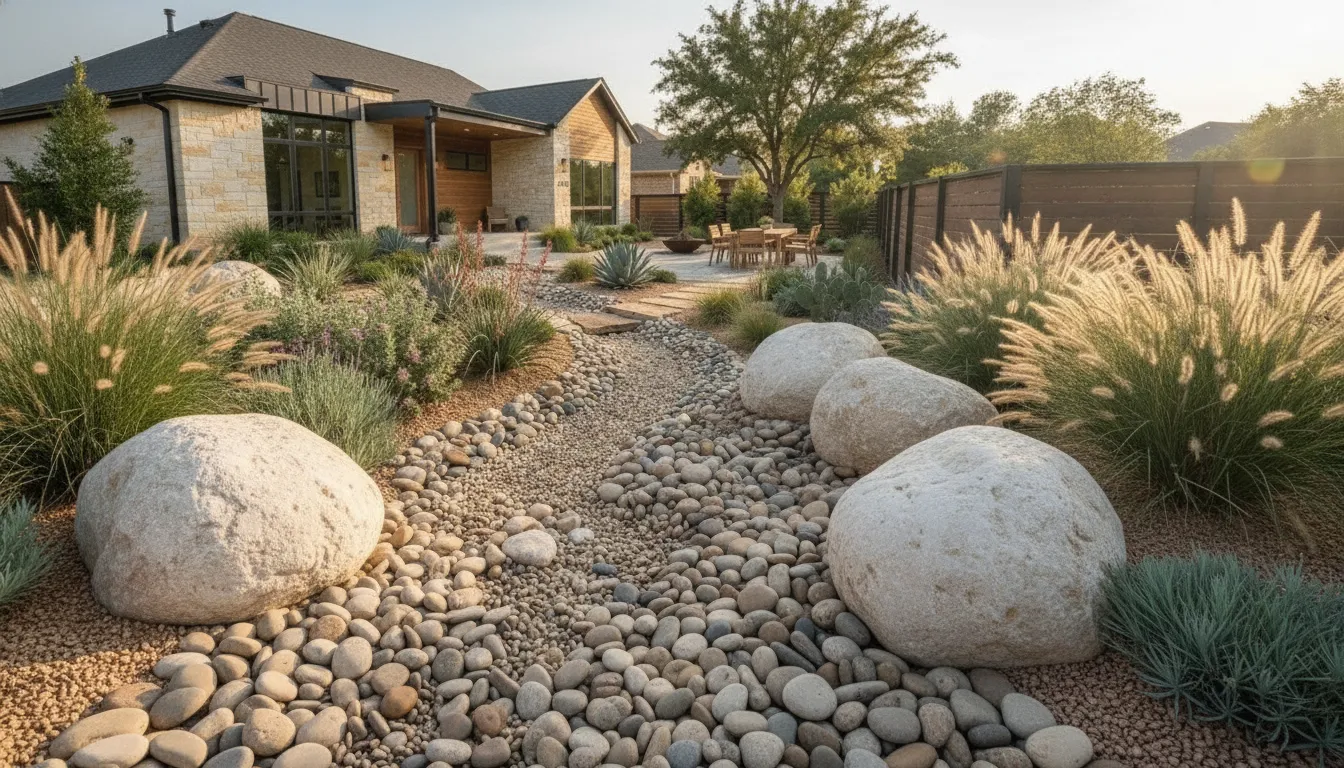
A few well-chosen stones can give a planting bed a finished edge, add structure beside a driveway, or make a broad North Texas yard feel more intentional. The hard part is choosing rock that fits the space instead of simply choosing the biggest pieces available. Size, color, texture, quantity, access, and the purpose of the bed all affect the final result.
Ready to choose your material? Browse McCraw’s landscape rock products, then use the area calculator to estimate quantity before you order.
Planning large decorative rocks for yard projects starts with matching the material to the viewing scale and use of the space. Measure the area, choose a size range, plan the layout, and check the route for delivery or placement before ordering.
This guide focuses on selecting and planning decorative rock for landscape beds, borders, dry creek features, and accent areas. It is not a substitute for an engineered drainage, retaining-wall, or structural plan. If a site has concentrated runoff, unstable soil, or a difficult slope, solve that site condition first and use decorative stone as the finish rather than the fix.
How to Choose Large Decorative Rocks for Yard Projects
Short answer: Choose large decorative rock by yard scale and viewing distance. Also consider the job the material must perform. A broad bed may need a blend of sizes. A narrow border may need smaller pieces that leave room for mowing and walking. A focal area may need only a few larger stones surrounded by compatible ground cover.
The phrase “large decorative rocks” can describe several landscape materials. It may mean larger river rock spread across a bed, a group of feature stones placed among plants, or individual landscape boulders selected for shape and visual weight. Those choices are related, but they are not interchangeable. Start by naming the role the rock will play, then select material that supports that role.
Begin with the space, not the product name
Measure the bed or feature area and view it from the places that matter. Check the sightline from the street, driveway, front walk, patio, and the main windows of the house. A stone that looks substantial beside a small entry bed may disappear beside a long foundation. The same stone may feel oversized when placed close to a narrow path.
Leave room for the things that already use the space. Walkways, gates, irrigation controls, cleanouts, downspouts, edging, planting pockets, and mowing routes should remain accessible. Contractors should also consider how a crew will maintain the landscape after installation. A dramatic rock that blocks routine access can create more work than it adds visual value.
Decide whether you need coverage, transition, or a focal point
Coverage material creates a more continuous surface across a bed. Transition material helps connect a path, planting group, dry creek feature, or larger accent to the surrounding landscape. A focal point is a deliberate visual stop, often created by one or several stones that are larger than the surrounding material.
These roles can work together. For example, a planting bed might use a consistent layer of medium rock, a few larger accents near a curve, and a smaller transition near the walkway. The design looks more natural when the largest pieces have a reason to be there rather than appearing randomly scattered.
Keep the North Texas setting in mind
North Texas landscapes have intense sun, seasonal storms, and soils that can hold water. Blackland Prairie clay may drain slowly, so decorative rock should not be used to conceal a low spot without first understanding where the water goes. Observe the area after rain and keep the finished surface from directing runoff toward a structure.
For homeowners in Van Alstyne and Anna, local conditions also affect how a color reads. Strong sunlight can make pale stone appear brighter, while shade can bring out gray, tan, or warmer tones. Look at a material in the setting where it will be used. A small sample can help, but a full load may show more variation in shape, moisture, and color.
What Counts as Large Decorative Rock?
There is no single size cutoff that makes a rock “large” in every yard. Scale is relative to the bed, the surrounding plants, the hardscape, and the viewing distance. A two-inch river rock can be a large finish for a narrow planting strip, while a broad commercial entrance may need much larger feature stone to remain visible.
River rock for visible texture and flow
River rock is commonly rounded and works well when the design calls for softer texture or a flowing transition. McCraw’s Austin River Rock is a limestone-based material with soft neutral hues. The listed size choices include 5/8-1 inch, 1-2 inch, and 2-4 inch options. Those ranges can support different jobs, from quieter bed coverage to a more noticeable border or creek-bed treatment.
Brazos River Rock is listed in 1-2 inch, 2-4 inch, and 3-5 inch sizes. Llano River Rock includes sizes up to 4-6 inches. Confirm current availability and exact sizing before ordering because natural material can vary by load and inventory. Rounded rock can migrate on steep or fast-flowing areas, so it should be contained and used with a site-appropriate drainage plan.
Feature stone for visual anchors
Feature stone is selected for its individual shape, color, and position in the composition. Use it to anchor the end of a bed, frame a planting group, soften a hardscape corner, or give a large open area a readable focal point. A group of related stones often looks more intentional than a single piece placed without a connection to the rest of the yard.
Feature stone is not automatically the right choice for a walkway, a narrow gate route, or a surface that must remain easy to cross. Consider how much space the rock will occupy after planting grows around it. Contractors should also account for the equipment and crew needed to move heavier pieces without damaging paving or irrigation.
When boulders are a different buying decision
Landscape boulders are a more specific product choice than broad decorative-rock coverage. They are usually purchased as individual accents or grouped features. If your project is centered on hand-selected boulders, review McCraw’s landscape boulders. This article stays focused on choosing and estimating decorative rock for a yard, including mixed-size beds and material transitions.
The distinction helps prevent an expensive mismatch. Do not order a truckload of coverage rock when the design calls for a few large accents. Do not choose individual boulders when the goal is a consistent, walkable bed surface. Define the quantity and role first, then compare material options.
Which Rock Sizes and Materials Fit Your Yard?
Quick answer: Smaller aggregate is easier to spread and walk around, medium river rock adds visible texture and movement, and large feature stone creates focal points. The best combination depends on the bed size, viewing distance, planting plan, and maintenance route.
| Material role | What it contributes | Where it fits | Planning caution |
|---|---|---|---|
| Smaller aggregate | Consistent coverage and a quieter background. | Narrow beds, planting pockets, edges, and areas with regular access. | Define edges so material does not migrate into grass or paths. |
| Medium river rock | Rounded texture and a visible transition. | Dry creek features, native gardens, borders, and broad beds. | Review slope and water flow because rounded pieces can move. |
| Large feature stone | Strong focal points and visual scale. | Entry accents, bed curves, open yards, and grouped landscape features. | Plan equipment, access, stable placement, and maintenance clearance. |
Use size to create a readable composition
A useful layout usually has a dominant size, a supporting size, and a transition. A broad bed might use medium rock as the dominant finish, larger pieces at key turns, and plants or smaller stone to soften the edge. Repeating the same size at regular intervals can look mechanical, while using too many unrelated sizes can make the bed look unsettled.
Place the largest pieces where they will be seen and where they support the shape of the bed. Avoid putting a bulky rock directly at a gate, beside a door swing, or in the normal path of a mower. Use lower material near pedestrian routes and reserve taller or heavier accents for areas with enough clearance.
Compare color, shape, and texture together
Color is only one part of the decision. Rounded river rock creates a different impression from angular crushed stone, even when the colors are similar. Smooth pieces can make a bed feel softer. Irregular pieces can add stronger contrast around clean architectural lines. The house siding, roof, pavers, fencing, and plant foliage should all be considered as part of the palette.
Natural stone varies. Moisture, lighting, size, quarry source, and the particular load can change how the material looks. Ask about the current material rather than relying only on a catalog image. McCraw’s rock selection includes decorative and functional materials, so the landscape rock product category is a practical place to compare available options before narrowing the order.
Once you have a likely material and size range, compare the available rock products before finalizing the order.
How Much Rock Does Your Project Need?
Quantity depends on the area, planned depth, material gradation, and whether the rock will sit directly over soil, over a compacted base, or within a designed drainage assembly. A visual estimate is rarely enough for a larger bed. Measure each section and combine the areas before requesting material.
Measure irregular beds in sections
For a rectangle, measure length and width. For an L-shaped or curved bed, divide it into smaller rectangles or manageable sections, calculate each section, and add the results. Mark the measurements on a simple site sketch. Include planting pockets, paths, and areas that will receive a different material so they are not counted twice.
Depth should match the intended use and the material. A decorative bed, a path, and a driveway edge may need different assemblies. Do not copy a depth from an unrelated project. Ask the supplier to review the material, soil, traffic, and drainage conditions before treating a depth as a final order specification.
Use the calculator as a planning tool
McCraw’s area calculator helps organize length, width, material, and depth. It is a starting point for estimating the amount of material needed, not a substitute for checking unusual shapes or site conditions. Add separate measurements for sections that use different rock sizes or depths.
For a contractor, the same measurement process improves the handoff between estimating, ordering, and installation. Record the bed dimensions, selected material, planned depth, access notes, and any areas that need a separate base or drainage solution. For a homeowner, that information makes a product and delivery conversation more useful and reduces last-minute changes.
Allow for natural variation and project waste
Rock is not a perfectly uniform manufactured surface. Pieces vary in shape and may settle or nest differently. Curves, planting openings, transitions, and small corrections can also change the final quantity. Use the calculator to create a starting estimate, then ask McCraw to review the plan before ordering a large load.
Do not solve a quantity question by ordering an arbitrary extra amount. Too little material can leave thin spots. Too much can bury edging, raise the bed against siding, cover cleanouts, or create a disposal problem. A clear measurement and a material-specific review are better than guessing.
How Should You Design and Prepare the Bed?
Good preparation makes the rock look intentional and helps it remain where you place it. Start with the outline of the bed, then resolve grade, access, edging, planting, and drainage before spreading material. Rock should finish the landscape, not hide unresolved site problems.
Shape the boundary and protect access
Use a hose, stakes, or marking paint to test the bed shape from several viewpoints. Keep transitions clean where the rock meets grass, concrete, pavers, siding, and planting areas. Preserve access to irrigation controls, drainage inlets, cleanouts, and utility features. If the bed borders a walk, leave enough room for normal foot traffic and maintenance.
On a slope, plan containment before delivery. Edging, planting pockets, terraces, or a defined channel may help limit migration, but the correct solution depends on the grade and water path. Rounded decorative stone is not a replacement for engineered erosion control or a drainage system.
Prepare the soil and grade
Remove vegetation and loose organic material from the installation area. Shape the surface so water moves toward its intended outlet and away from foundations, door thresholds, siding, and wood. Compact soft spots after the grade is established. If the ground remains unstable or wet, pause the decorative finish and address the subgrade first.
Landscape fabric may separate rock from soil in some beds, but it does not correct poor grading, standing water, or weak soil. Use it selectively, secure its edges, and cut planting openings carefully. The bed still needs a plan for weeds, edging, maintenance, and future plant growth.
Place accents with the mature landscape in mind
Set the layout before the final load arrives. Mark likely focal points and check how they relate to mature plants, windows, doors, and the street view. Keep larger features from creating trip hazards or blocking equipment routes. A feature that looks balanced when the bed is empty may feel crowded after shrubs and ground cover fill in.
For persistent runoff, steep slopes, or water near a structure, get the site condition reviewed before choosing decorative stone. McCraw can help with material selection, but a drainage or structural problem may require a qualified landscape or drainage professional.
How Do You Plan Delivery and Placement?
Delivery planning is part of material selection when the project uses large or heavy rock. A bed may be easy to reach with a wheelbarrow but difficult for a delivery truck, loader, or placement machine. Measure the route before scheduling the load, especially in established yards with fences, low branches, narrow gates, and soft ground.
Measure the full route
- Measure the route. Record the narrowest gate, driveway width, overhead clearance, turning space, slope, and distance from the drop area to the finished bed.
- Flag hazards and protected features. Note fences, roof overhangs, parked vehicles, irrigation lines, septic systems, utility features, foundations, and paving that could be damaged.
- Share the access notes early. Give the supplier those details when discussing the order rather than waiting until the truck arrives.
Choose a practical drop point
The best drop point is close enough to reduce handling but stable enough to support the load and equipment. Keep it clear of sidewalks, drainage paths, doorways, and other active work areas. North Texas clay can become soft after rain, so a route that works in dry weather may not be suitable after saturation.
Coordinate whether material will be dumped, spread, or individually placed. Larger feature pieces may require equipment or a coordinated crew. Never stand beneath a suspended load, keep hands and feet out of pinch points, and do not attempt a lift that exceeds the team’s safe capacity. Protect paving and keep children, pets, and bystanders outside the work zone.
Confirm the order before material moves
Before the delivery is scheduled, confirm the product name, size range, quantity, intended placement area, access notes, and any separate materials. Natural rock can vary by load, so verify that the current material matches the design direction. If availability changes, review the substitute instead of accepting a different size or color without checking how it affects the layout.
Need help matching material to your yard and access conditions? Contact McCraw Landscape Supply before you order so the delivery and placement plan fit the job.
Frequently Asked Questions
What are large decorative rocks for a yard usually called?
They may be called decorative rock, feature stone, landscape rock, river rock, or landscape boulders, depending on the material and use. River rock is often used for coverage, transitions, and dry creek features. Boulders are usually individual accent pieces. Define the job first because the product name alone does not determine the correct size or quantity.
What size decorative rock should I use around a planting bed?
Choose a size that remains visible from the normal viewing distance while leaving room for plants, edging, walking, and maintenance. Smaller material suits narrow beds and areas with frequent access. Medium river rock creates more visible texture. Larger feature stone works best as a deliberate accent in a space with enough clearance.
How do I calculate how much decorative rock I need?
Measure each section’s length and width, account for the planned depth, and separate areas that use different materials. Use the McCraw area calculator as a starting estimate. Confirm unusual shapes, slopes, drainage assemblies, and large feature-stone orders with the supplier before ordering.
Can decorative rock solve a wet area in my yard?
Decorative rock alone does not correct a low spot, reverse a slope, or redirect runoff away from a structure. Grade and drainage should be addressed first. Rock may be part of a finished drainage feature, but steep slopes, concentrated flow, erosion, or water near a foundation deserve a site-specific review.
What should I check before delivery?
Measure gates, driveways, overhead clearance, turning space, slopes, and the distance to the drop or placement area. Identify paving, irrigation, utilities, septic systems, cleanouts, foundations, and soft ground. Confirm the material, size, quantity, and access notes with the supplier before delivery is scheduled.
Ready to Plan Your Large Decorative Rock Project?
Start with the yard’s purpose and viewing scale, then measure the areas that will receive material. Compare rock size, color, shape, and texture with the existing home and landscape. Finally, confirm the quantity, access route, and site preparation before ordering.
McCraw Landscape Supply serves homeowners, contractors, builders, and landscapers in Van Alstyne, Anna, and surrounding North Texas communities. Review the rock selection, estimate your material with the calculator, and contact the team with your measurements and delivery questions.
