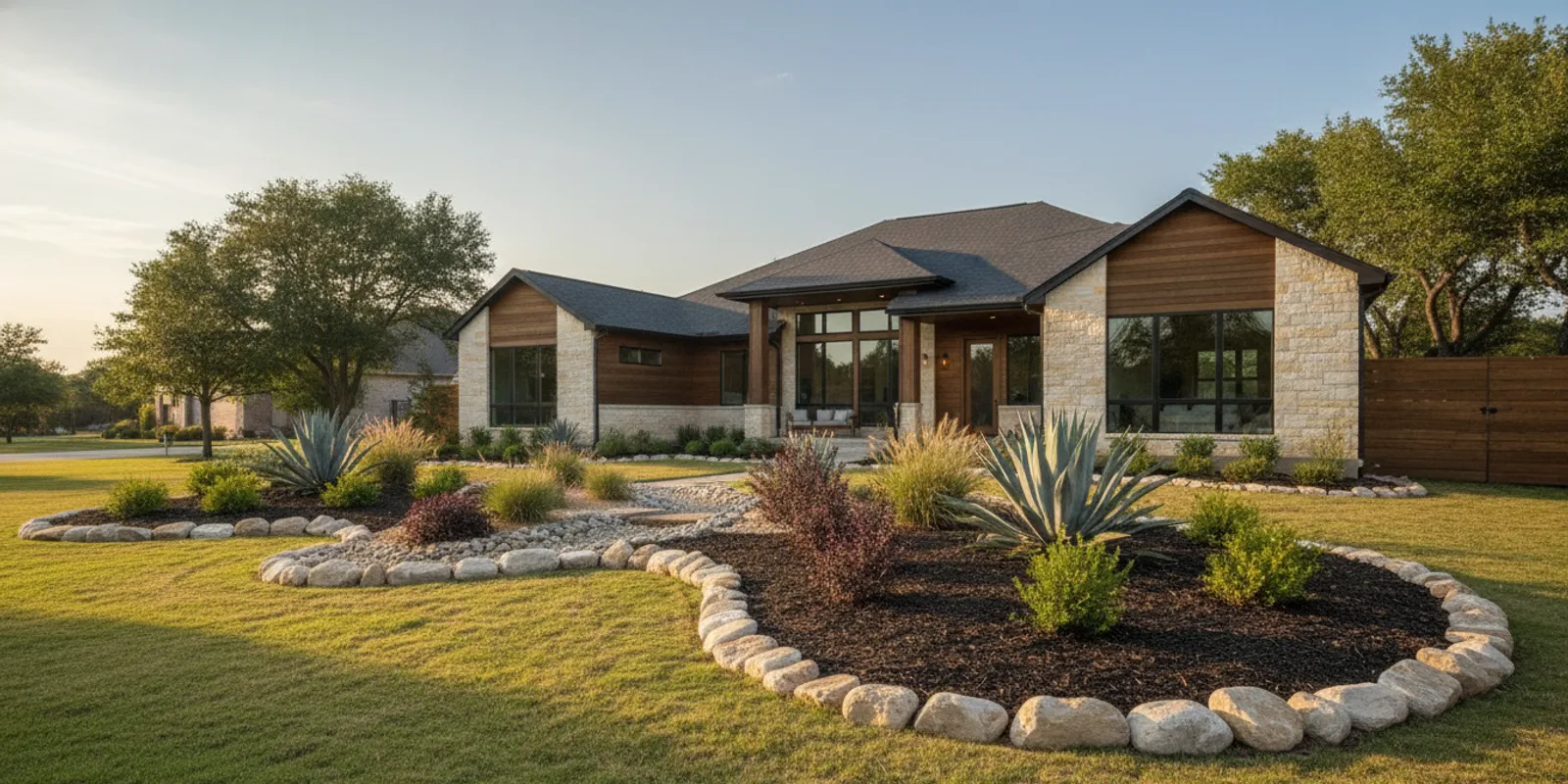
A rock calculator helps turn bed dimensions into a useful order estimate. For a rectangular area, multiply length by width, then multiply square footage by the planned depth in feet and divide by 27 to get cubic yards. For example, a 200-square-foot bed covered 3 inches deep needs about 1.85 cubic yards before any allowance for uneven ground or settling.
What does a rock calculator estimate?
A rock calculator estimates volume from area and depth. It does not decide which stone suits the site, guarantee exact coverage, or account perfectly for every slope and irregular edge. Treat the result as a planning figure, then confirm material, delivery and quantity before ordering.
For decorative beds, the usual inputs are the area to cover and the finished layer depth. The answer is commonly expressed in cubic feet or cubic yards. Weight is a separate estimate because different rock types and sizes can weigh differently. Use a volume calculation first; ask the supplier how the selected product is sold and whether a ton conversion is available for that exact material.
Planning has three distinct jobs: establish the footprint, set a suitable depth, and translate that volume into the unit used for the order. Keeping those steps separate makes the estimate easier to check. If the final number seems unexpectedly large, you can identify whether the area, depth or unit conversion caused it rather than changing the answer blindly.
How do you measure a bed?
Measure the area that will actually receive rock, not the whole yard. Use a tape measure and record dimensions in feet. For a rectangle, multiply length by width. Split an L-shaped or complex bed into simple rectangles, calculate each, then add the areas.
- Rectangle: length × width.
- Triangle: base × height ÷ 2.
- Circle: 3.14 × radius × radius.
For curved borders, divide the space into several smaller shapes or estimate a central length and average width. If the outline is very irregular, measure several sections rather than relying on one broad estimate. Keep a simple sketch with dimensions so you can check the math and explain the project when requesting material.
Mark the edges that are included. A bed may wrap around a porch, tree or walkway, and the entire outline is not necessarily covered. Measure those exclusions as separate shapes and subtract them from the total. For example, a 240-square-foot rectangular bed with a 12-square-foot paved inset has 228 square feet of rock area, assuming the rest of the surface is covered uniformly.
For a long, narrow strip, measure its length and average width at several points. If the width varies from 3 feet to 5 feet, using only the widest measurement overstates the footprint. Add the measured widths and divide by the number of readings to find a practical average, then multiply by length. This is still an estimate; dividing a sharply changing shape into smaller sections gives a better result.
McCraw’s area calculator can help with area-based planning. Check the inputs and units carefully, then use the depth and volume formula below to convert the result into a rock quantity. The crushed stone calculator guide also explains how area estimates relate to yards for stone projects.
How deep should the rock layer be?
Depth depends on the rock size, the surface beneath it, and the look and function you want. A thin layer may leave fabric or soil showing. A thicker layer uses more material and can change edging height, drainage patterns, or access around plants. Do not choose depth solely to make the calculator return a convenient number.
As a planning method, convert inches to feet by dividing by 12. Thus, 2 inches is 2/12 feet, or about 0.167 feet; 3 inches is 0.25 feet; and 4 inches is about 0.333 feet. Check that the planned depth works with the selected size of rock and existing borders. If the bed has low and high spots, measure representative areas and consider whether grading or preparation is needed before spreading stone.
Think about the finished elevation as well as the material quantity. If rock is added beside a walk, curb or edging, compare the intended top of the layer with those boundaries. Around plants, consider how the layer will meet stems and existing soil rather than assuming a uniform depth is suitable everywhere. The calculator cannot resolve those site decisions; use the number only after deciding what layer you intend to build.
McCraw carries several types of decorative landscape rock, as well as gravel products. Comparing product size and appearance before calculating can help avoid estimating one depth for a material that needs another approach.
How do you calculate cubic yards?
Use this formula when area is in square feet and depth is in inches:
Cubic yards = square feet × depth in inches ÷ 324
The divisor 324 combines 12 inches per foot and 27 cubic feet per cubic yard. Alternatively, convert depth to feet, multiply by square footage to get cubic feet, and divide that number by 27.
Worked example: a 200-square-foot bed
- Measure the bed: 200 square feet.
- Choose a planning depth: 3 inches.
- Multiply 200 × 3 = 600.
- Divide 600 by 324 = about 1.85 cubic yards.
This is the calculated volume, not a promise that a specific delivered amount will cover every site exactly. A sloped bed, uneven subgrade, settling, or measurement error can change the amount required. Review the site conditions and determine whether a modest allowance is appropriate before placing an order.
A second example shows why depth matters. At 200 square feet, a 2-inch layer calculates to 400 ÷ 324, or about 1.23 cubic yards. At 4 inches, it is 800 ÷ 324, or about 2.47 cubic yards. The area stayed the same, but doubling depth doubled the volume. If two estimates differ substantially, verify that they use the same depth and units.
For a multi-section bed, calculate each section before adding them. Suppose one rectangle is 120 square feet and another is 80 square feet, both at 3 inches. Their combined area is 200 square feet, so the total is 1.85 cubic yards. If the depths differ, calculate each section separately: 120 square feet at 3 inches is about 1.11 yards, while 80 square feet at 2 inches is about 0.49 yard. Add those results, about 1.60 cubic yards, rather than applying one depth to the combined area.
Round only after performing the arithmetic. Rounding each small section up before adding can inflate a total, while rounding down can understate it. Keep two decimal places during planning, then confirm what quantities and increments are available for the chosen product.
How do cubic yards convert to tons?
Cubic yards measure volume; tons measure weight. There is no dependable single conversion that applies to every decorative rock. Rock type, size, shape, moisture and packing can affect weight. Avoid using a generic online conversion as a precise order quantity.
If a supplier provides a product-specific approximate tons-per-yard factor, multiply your cubic yards by that factor. For instance, if the quoted factor for the chosen material were 1.4 tons per cubic yard, 1.85 cubic yards would be about 2.59 tons. That example only demonstrates the arithmetic; it is not a weight specification for any McCraw product. Confirm the appropriate factor and ordering unit for the actual rock.
Ask whether the number is an estimate or a guaranteed conversion, and whether it applies to the precise rock and size you selected. Do not use a factor from one stone to estimate another simply because both are sold for landscape beds. For a project specified in yards, keep your calculation in volume until the supplier confirms the ordering method; for a project quoted by ton, request the product-specific conversion before treating the calculation as final.
| Planning step | What you know | What to verify |
|---|---|---|
| Measure area | Square feet from the bed dimensions | Units and whether all sections are included |
| Set depth | Inches of planned coverage | Fit with rock size, edging and site conditions |
| Calculate volume | Cubic yards from area and depth | Allowance for slope, unevenness or settling |
| Estimate weight | Approximate tons if a factor is supplied | Product-specific factor and sale unit |
How should you handle irregular beds and an ordering buffer?
Break a winding bed into smaller sections, measure each, and add the results. For a kidney-shaped or curved space, use rectangles and triangles to approximate the outline, taking care not to count overlaps twice. A sketch and section-by-section list make it easier to identify a missed strip or an area that should remain uncovered.
Then compare the calculated volume with the real surface. A compact, level bed may be close to the formula. A sloped or rough bed can take more material to achieve an even layer. Instead of automatically adding a large percentage, identify the source of uncertainty: an uncertain dimension, variable depth, loose soil, or an irregular boundary. Re-measuring an uncertain section may be better than padding the entire estimate.
A practical way to handle uncertainty is to list assumptions beside the calculation. Note whether the bed is level, whether the depth is consistent, and whether obstacles were removed from the measured area. If one section is noticeably lower than the rest, estimate its area and depth separately. That targeted approach is more useful than adding an arbitrary amount to every part of the project.
For example, if your first measurement suggests 1.85 cubic yards but a curved edge was only approximated, revisit that edge. Measure it in three or four segments and compare the revised area with the sketch. If the result changes only slightly, the initial estimate may be adequate for planning. If it changes materially, update the calculation before seeking a quote. No single buffer percentage suits every site, so base any extra on a specific reason and confirm order increments.
For an order, consider access and placement too. Decide where a bulk delivery can be placed, how far material must be moved, and whether the site is ready. McCraw supplies rock and other landscaping materials; its bulk landscape rock planning guide covers quantity and delivery considerations. You can also review gravel versus river rock when comparing appearance and use.
Which rock should you compare before ordering?
Choose for the job and the finished look, not just the calculator result. Decorative river rock offers a rounded appearance; crushed stone and gravel have different shapes and may suit different applications. Color, stone size, neighboring materials and maintenance preferences all influence the choice.
Take a moment to look at the bed from nearby paths and windows, and consider how the material will sit beside existing stone, siding or planting. A small difference in size can change the visual texture and the way a layer fills around edges. If the area has a specific functional purpose, such as directing movement or covering a defined bed, compare the product characteristics with that purpose rather than selecting on color alone.
Browse the rock category and available landscape materials before finalizing measurements. For a project involving gravel, compare the relevant gravel options as well. A calculator cannot replace checking that the material and size match the intended bed.
What should you confirm before placing an order?
Use a short review to catch errors while there is still time to revise the quantity. Keep the area, depth and volume written together rather than saving only the final number. That record also helps a contractor or supplier understand how you arrived at the estimate.
- Confirm dimensions, units and total square footage.
- Confirm the planned depth and whether it suits the rock size.
- Record the calculated cubic yards and any assumptions.
- Ask whether the selected product is quoted by yard, ton or another unit.
- Verify any product-specific weight conversion instead of assuming a universal factor.
- Check delivery access, placement location and site readiness.
For a larger job, separate the takeoff by area or phase. A builder or landscape contractor may have several beds with different depths or finishes. A section-by-section list lets the crew stage material in the right location and reduces the chance that a single average hides a substantial difference. Keep the same units throughout each calculation, then summarize the total in the unit used for the order.
Check that access is practical for the planned delivery and that the unloading location is clear. Consider gates, low branches, parked vehicles and the distance from the drop point to the bed. The estimate describes material quantity, not whether the material can be placed exactly where it is needed. Confirm those logistics when discussing the order so the project plan reflects the site.
North Texas projects can involve varied soils and changing weather, so look at the actual site rather than assuming every bed is level or alike. McCraw serves the region with landscaping and construction materials, including Anna-area supply information and Van Alstyne-area information. Contact the team with your measurements and the product you are considering to discuss the order details.
For additional background on measuring area and depth to estimate rock, see the FAS3 rock quantity calculation overview. Its stated method supports the basic relationship between the covered area, intended depth and estimated volume; the project-specific measurements and product conversion still need to be checked for your site.
Frequently asked questions
What is the formula for a rock calculator?
For square feet and inches of depth, multiply square footage by depth in inches and divide by 324 to estimate cubic yards. For other units, convert them first so the calculation uses consistent measurements.
How many cubic yards are in a ton of rock?
It depends on the rock and its density, so there is no one conversion that fits all products. Use a product-specific estimate from the supplier when converting calculated volume to weight.
Should I add extra rock to my estimate?
Allow for uncertainty only after checking measurements, depth and surface conditions. Slopes, uneven ground and irregular edges may affect coverage, while a careful re-measurement can reduce guesswork.
Can an area calculator tell me how much rock to order?
An area calculator can help determine the footprint. To estimate rock, you also need a planned depth and a conversion from volume into the product’s sales unit. Review the result and verify the final quantity before ordering.
Request help planning a bulk material order
Measure the bed, choose a depth that fits the site and rock size, then use the result as a starting estimate and confirm product-specific ordering details before delivery.
